

Truffles in the Langhe: Research, Seasons, and Curiosities
The truffle is not a root and, despite the scientific name Tuber, it is not even a tuber. It is the visible – or rather, hidden – part of a fungus that grows underground in close relationship with the roots of some trees.
In the Langhe, truffle research combines nature, experience and tradition. The most famous protagonist is the fine white truffle, but at different times of the year you can also find black truffles, whitebait and scorzone.
To truly understand them, it is not enough to taste them. You need to know the soil in which they grow, the work of the trifolaus, the smell of the dog and the environmental conditions that make each season different from the previous one.
Truffle is a fungus that lives in symbiosis with trees
The truffle is a hypogeous fungus, that is, a fungus that develops its fruiting body below the soil surface.
Its life depends on its relationship with the roots of certain plants, such as oaks, downy oaks, hazelnuts, hornbeams, lime trees, willows and poplars. Through this symbiosis, the fungus receives nutrients from the tree and, in return, helps expand the roots’ ability to absorb water and minerals.
It is therefore not enough to plant a suitable tree to obtain truffles. They are needed simultaneously:
- a soil with favorable characteristics;
- the presence of the fungus and symbiotic plants;
- correct soil moisture;
- temperatures compatible with the species cycle;
- a sufficiently balanced and oxygenated environment.
It is this set of conditions that makes some areas particularly suitable and others completely unsuitable.
Why truffles grow in some places and not others
Areas where trifolaus returns over the years are traditionally called pasture. They are not places where the presence of truffles is certain, but environments that possess characteristics considered favorable.
The seeker observes the type of soil, the trees present, the vegetation, the exposure, the humidity and the changes that have occurred in the forest. His experience also helps us understand when a truffle ground is losing vitality or when a season may be later than usual.
A natural truffle ground is a delicate environment. Abandonment, excessive forest closure, prolonged drought, improper soil cultivation, and extreme weather events can compromise its balance.
In 2026, the Piedmont Region provided new support specifically for the improvement and environmental restoration of natural white truffle orchards, alongside protection initiatives to raise awareness of these environments.
How truffle hunting really happens
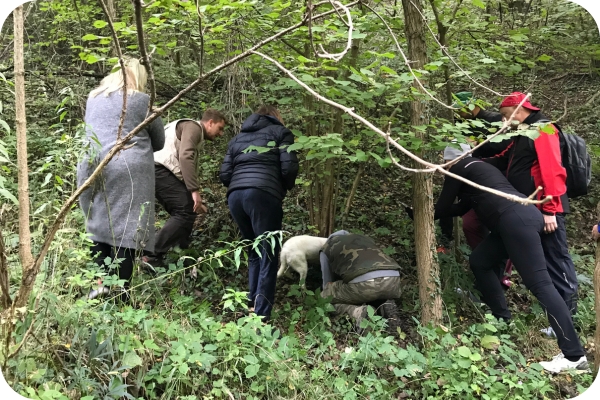
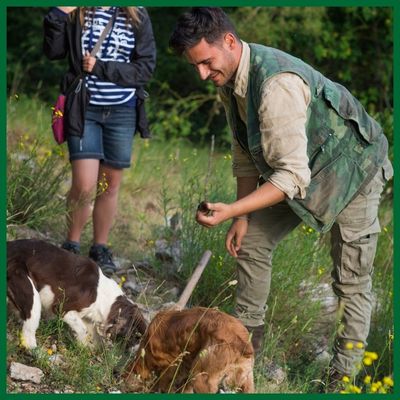
The research takes place together with a trifolaus and his trained dog. It’s not just about freeing the dog in the woods and waiting for him to find something.
The trifolaus chooses areas to explore, interprets the animal’s behavior, and recognizes signs in the terrain. The dog follows the scent trails that come from underground and, when it spots an interesting spot, generally begins to scrape.
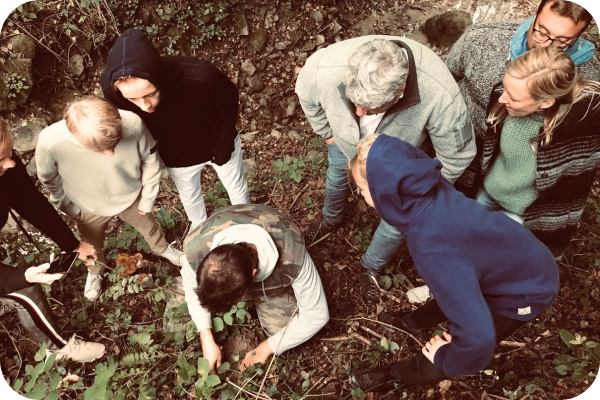
At that point, the prospector intervenes, using the spanghettoto gently remove the soil. After possible harvesting, the hole must be carefully covered to limit damage to the roots and the truffle environment.
The truffle is then placed in the traditional trifolaus bag, often called catana.
An authentic search does not guarantee finding a large truffle. The result depends on the season, soil, climate, maturation, and the dog’s work. Experience also consists of observing this relationship and understanding how difficult it is to predict what is happening underground.
Does the dog find the truffle on its own?
The dog has an extraordinary sense of smell, but the research stems from collaboration with the trifolau.
The animal must learn to recognize and signal the scent of truffles, ignoring the many other traces present in the soil. Training often begins as a game, associating smell with a reward and gradually increasing the difficulty.
The Lagotto Romagnolo is the best-known truffle dog, but it is not the only one suitable for the job. Dogs of other breeds and mixed breeds can also become excellent seekers, as long as they have curiosity, concentration, a good relationship with the handler, and proper training.
In the past, pigs were also used because they had a highly developed sense of smell. However, the dog proved to be more manageable, gentler in the soil, and easier to train to return truffles.
Do you need a card to look for truffles?
The search and collection of truffles cannot be freely practiced by anyone.
In Piedmont, the prospector must have a specific suitability card, issued after passing an examination on the species, the truffle environments and the rules governing the collection. The minimum age to take the exam is 14 years.
The collection must also comply with:
- the expected calendar for each species;
- the periods of general detention;
- the use of the trained dog;
- the allowed tools;
- the correct closing of holes;
- any limitations established for specific areas.
Those who participate in a tourist experience therefore do not search independently: they accompany and observe the work of a licensed trifolaus.
The main truffle varieties in Piedmont
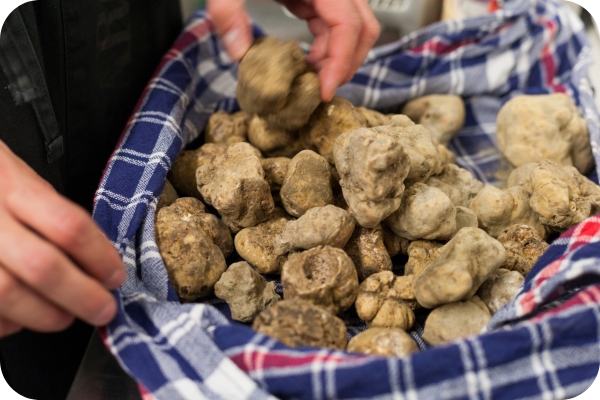
The white truffle is the most famous, but it is not the only species present in Piedmont. Each variety has its own ripening period and different aromatic characteristics.
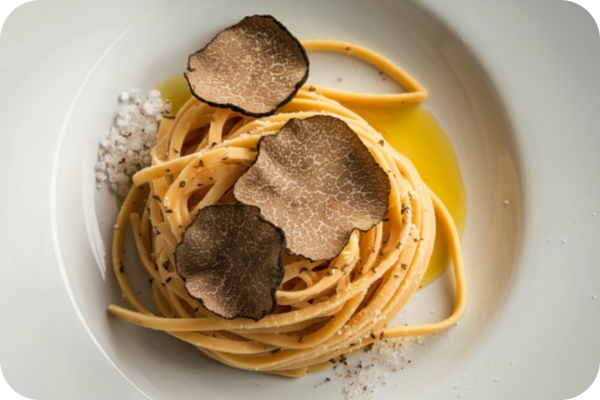
- Precious white truffle – Tuber magnatum Picco: is the most famous and sought-after. It has an intense aroma and is used raw, sliced on dishes at the moment.
- Precious black truffle – Tuber melanosporum: is a winter species, with a more regular aroma and a taste also suitable for cooking.
- Whitebait or marzuolo truffle (Tuber borchii): may resemble white truffle in appearance but has a more pungent, garlicky aroma.
- Summer black truffle, or scorzone (Tuber aestivum), has a milder scent and is generally more accessible.
- Hooked Black Truffle – Tuber uncinatum: ripens in the autumn season and has a more pronounced scent than summer scorzone.
The exact search dates should not be deduced only from the season indicated in the name. The regional calendar sets them and may be updated when provisions are revised.
When you can look for white truffles in Piedmont
The Piedmontese calendar currently in force includes the opening of the search for the fine white truffle from 1° October.
The Region has also modified the 2024 calendar to account for the effects of climate change and shifts in maturation periods.
The collection of all species is, however, prohibited:
- from 1° to May 31;
- from 1° to September 30.
This means that a tourist search organized in September could not be presented as a typical truffle-collection outing. When booking an experience, it is therefore important to always check the main species and the applicable calendar.
Drought, heat, and heavy rains: are truffles suffering from the weather?
Truffles need water, but the formula “more rain means more truffles” is too simple.
Above all, how humidity and temperatures are distributed during the months of development matters. Soil that remains dry for extended periods can hinder truffle formation and ripening. At the same time, very heavy, concentrated rainfall cannot always compensate for weeks of drought.
Extreme events can also cause erosion, stagnation, root damage, and changes in the fungus’s environment.
In general, the following are more favorable:
- rain distributed over time;
- temperatures without prolonged excesses;
- soils capable of maintaining correct humidity;
- well-managed woods and rows;
- absence of root-damaging work.
For this reason, two consecutive seasons can give very different results, even in the same truffle ground.
Does the white truffle only grow in the Langhe?
Tuber magnatum does not grow exclusively in the Langhe.
It is present in several Italian areas and in some areas of Central and South-Eastern Europe. There are also important truffle territories outside Piedmont and the international market includes truffles from different regions and countries.
Alba retains a unique role, however. Here the white truffle has become the center of a culture, a market and a territorial tale known throughout the world.
The name Alba white truffle therefore recalls a tradition and historical reputation, but does not automatically mean that every truffle marketed in Alba was harvested within the city limits.
Precisely for this reason, when purchasing a truffle, it is useful to ask for precise information on its origin and rely on transparent operators.
Where the scent of truffle comes from
The scent of truffle does not depend on a single substance.
It is made up of numerous volatile organic compounds, including sulfur molecules, alcohols, aldehydes, ketones and esters. Their combination can generate nuances reminiscent of garlic, damp earth, cheese, honey, hay, spices, or gas.
The flavor profile can change based on:
- species;
- degree of maturation;
- growth environment;
- soil characteristics;
- associated microorganisms;
- storage after collection.
This is also why two truffles of the same species do not necessarily smell in the same way or with the same intensity.
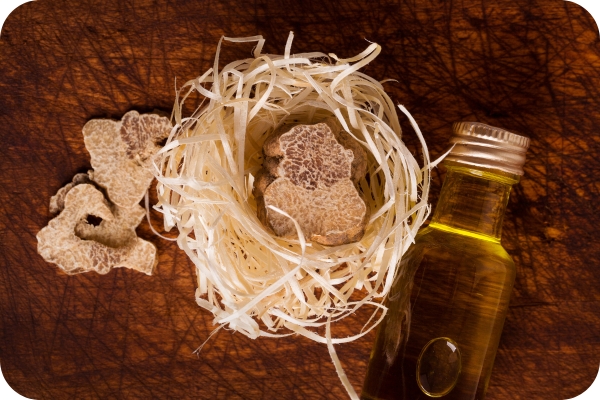
Can the scent of truffles be chemically reproduced?
It is possible to reproduce some aromatic notes that our brain immediately associates with truffles, but it is not easy to copy the entire profile of a fresh truffle.
One of the best-known molecules is 2,4-dithiapentane, a sulfur compound particularly associated with the aroma of white truffles. This substance, whether natural or produced for food use, can be used to create very recognizable aromas.
Fresh truffle, however, contains a more complex and variable combination of molecules. An aroma built around a single note therefore tends to be:
- more uniform;
- more immediate;
- more persistent;
- less nuanced.
This is why some flavored oils and seasonings may seem more intensely “truffled” than a real truffle.
A very strong perfume therefore does not, on its own, prove that a product contains a large quantity of truffle. To understand this, you need to read the list of ingredients and distinguish between truffles actually present and added flavoring.
Fresh truffle and flavoured products: they are not the same thing
Fresh truffle is a delicate and quickly perishable product. Its aroma changes after harvest and tends to diminish over time.
Flavored products are instead designed to offer a more stable and easily recognizable taste. They are not necessarily poor quality products, but they represent a different experience.
When purchasing a truffle oil, cream, sauce, or Cheese, it is helpful to check:
- the percentage of truffle declared;
- the species used;
- the presence of the word “aroma”;
- the position of the truffle in the ingredients list;
- the possible presence of other fungi.
A balanced product doesn’t necessarily need the most aggressive scent. Rather, it must state clearly what it contains.
From perfume to research: live the experience with Trifolao
With SlowDays, you can participate in a truffle hunt in the Langhe with trifolao and a dog, observe the work in its natural environment, and complete the day with lunch, a snack, or a tasting.
From the woods to the Alba Truffle Fair
The research tells the story of what happens before truffles arrive in kitchens, restaurants, and market stalls.
During the autumn, this route continues in Alba with the World Market, tastings, and International Fair events.
For dates, practical tips, and information about visiting, you can read our guide to the Fiera of the Alba White Truffle 2026.
The gift of a truffle search
A search for truffles can also become a gift for those who love nature, Piedmontese cuisine, and experiences to be enjoyed at a leisurely pace.
The person receiving the gift will be able to choose the date according to the conditions of the formula purchased and request the organization of the experience in the Langhe.
👉 Discover our experience gifts and SlowBox truffle formulas.
FAQ on truffle hunting in the Langhe
The Piedmontese calendar currently in force includes the opening of the search for the prized white truffle from 1° October. The final date and periods of the other species shall be checked on the updated regional calendar.
No. In an authentic search, the result depends on the season, soil, climate, degree of maturation, and the dog’s work. The value of the experience also includes encounters with the truffle and knowledge of the truffle environment.
To independently carry out research and collection in Piedmont, you need an eligibility card. During a tourist experience, however, participants accompany and observe the certified trifolau at work.
The Lagotto Romagnolo is the best-known, but it is not the only suitable dog. Other breeds and mixed breeds can also become excellent seekers with training, concentration, and a strong relationship with the handler.
Not necessarily. Regular monitoring of soil moisture and temperature trends throughout the entire development cycle is important. Very heavy rain after a long period of drought may not be enough and may also cause erosion or stagnation.
No. Tuber magnatum also grows in other Italian areas and in some European territories. Alba, however, remains the historic and commercial center that has made the white truffle known worldwide.
Not always; it can contain a very small amount. Some products owe their scent mainly to added aromas. It is important to check the list of ingredients, the percentage, and the declared truffle species.
Some characteristic notes can be reproduced, even using molecules associated with the aroma of white truffle. The scent of a fresh specimen, however, is composed of many compounds and presents a complexity that is difficult to fully replicate.
Generally, yes, as long as children are used to walking on natural terrain and follow the directions of the trifolaus. The route’s duration, accessibility, and difficulty must be assessed for the specific experience.
Yes. The research can be included in a day that includes lunch, a snack, a cellar tasting, or other experiences in the Langhe, taking into account the season, travel, and availability.
Comments